How AI is Reshaping the Software Industry
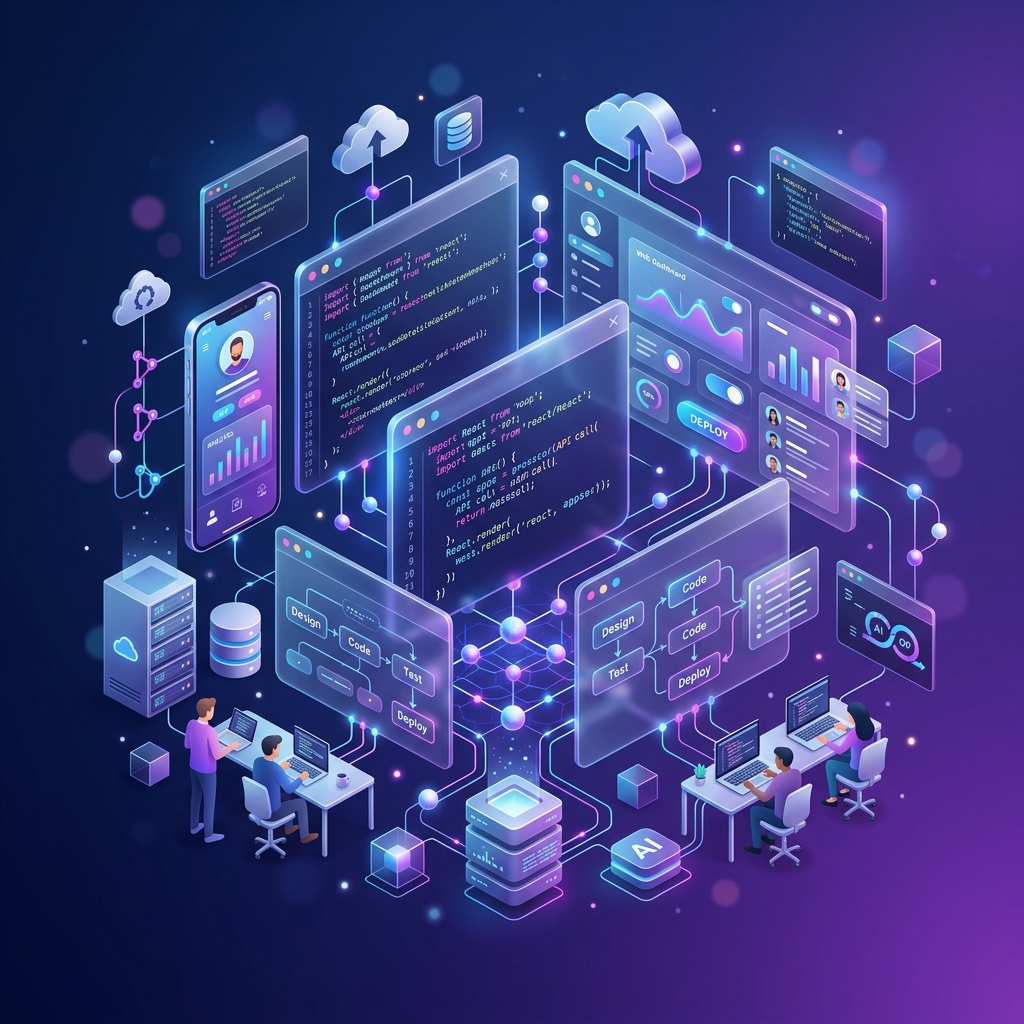
The software industry is experiencing a seismic shift, driven by the rapid advancement of Artificial Intelligence (AI). What was once considered the realm of science fiction is now an everyday reality, fundamentally altering how we conceive, build, and maintain software applications.
1. The Rise of AI-Assisted Development
The most immediate and visible impact of AI is in the development process itself. AI-powered coding assistants have evolved from simple autocomplete tools into sophisticated pair programmers. These intelligent agents can analyze context, suggest entire blocks of code, and even refactor legacy codebases with remarkable accuracy.
This doesn’t mean human developers are becoming obsolete. Instead, they are being elevated from “code writers” to “system architects.” Developers can now focus on high-level logic, user experience, and complex problem-solving, while AI handles the boilerplate and syntax.
2. Automated Testing and Quality Assurance
Quality Assurance (QA) has traditionally been a time-consuming and resource-intensive phase of the software lifecycle. AI is changing this by automating complex testing scenarios. Machine learning algorithms can automatically generate test cases based on user behavior patterns, identify edge cases that human testers might miss, and predict potential points of failure before deployment.
Furthermore, AI-driven static analysis tools are now capable of detecting subtle security vulnerabilities and performance bottlenecks, ensuring that software is not just functional, but also secure and highly performant from the outset.
3. Intelligent Operations (AIOps)
The integration of AI into IT operations, known as AIOps, is streamlining the deployment and maintenance of software. Modern applications are incredibly complex, often running in distributed cloud environments. AIOps platforms use machine learning to monitor system health in real-time, analyzing vast amounts of log data to detect anomalies and predict outages before they affect users.
By automating routine operational tasks and providing actionable insights, AIOps enables teams to maintain high availability and reliability with unprecedented efficiency.
4. Hyper-Personalized User Experiences
Beyond the development lifecycle, AI is transforming the software products themselves. Applications are becoming context-aware, capable of learning from user interactions to provide hyper-personalized experiences. From intelligent recommendation engines to natural language interfaces, software is becoming more intuitive and adaptive.
The Future of Software is AI-Native
We are moving away from software that merely “uses” AI towards “AI-native” applications—systems designed from the ground up with AI as their core engine. As we look to the future, the companies that thrive will be those that embrace AI not just as a tool, but as a fundamental paradigm shift in how digital value is created.
The software industry is no longer just about writing instructions for computers; it’s about teaching them to collaborate with us to build a better, more intelligent digital world.